Listen to chapter audio by clicking play above… Listen and Read at the same time to improve your “focusing fortitude” :0) Pictures related to chapter can be found by scrolling to bottom of this page. Enjoy the ride…
The Real GOOD Loser, A Story That Could…
Chapter Three: Setting the Stage
“The contest has got to be about connecting with someone…Connecting with the world.”
—from the film Ready Player One
When the time is right life will teach you more than any classroom ever could. The date was Thursday, March 19th, 2020, and a lesson was waiting for us whether we wanted it or not….
Standing at my school’s back entrance, I find myself looking out the glass doors waiting for the students’ bus to arrive. Behind me cafeteria staff are preparing the morning meal—smells like those French Toast sticks again.
The day ahead promises to be anything but normal. All teachers have been told to pack up their classes and prepare to educate students remotely for a bit. No one really understands what that means yet.
All the real teachers are in line at the copy machine preparing packets to send home with students. Principal Sam just finished telling me that since I have no “real curriculum” to cover it will be my job to “babysit” for the day; so that all the real teachers can scramble to send sufficient work home. Principal Sam says we may be home for a while. I don’t believe it.
Before the school day begins I like to keep my troublesome mind occupied by reading a book. Looking out these glass doors I’m having a hard time concentrating as I try to imagine a world different than this one; to paint a picture of a future different than the one I think is in front of us.
At the very same time my distracted and overwhelmed and bored mind is trying to think of something to say to Lauryn.
There has to be something I can say to you Lauryn. Something to wake you up. A way to give you some hope. See—secretly Lauryn—I kind of think this world sucks too. But I shouldn’t tell you that. I’d need a time machine to go back and fix everything…When would I go back and start changing things anyway?
When I was in middle school I had a teacher who found this picture of a boy from the depression a hundred years ago. Crouched down in some ditch holding both knees, the photo was in black and white but the boy in it really did look just like me. He even had one big ear—his left one—just like me.
An older boy on the school bus once told me he had an ear like mine. He told me he taped it when he slept and that fixed it. I taped mine for a month after he told me that. It still sticks out.
That photo of the boy from the depression had us middle-school kids talking about reincarnation that day: the belief we live multiple lives. As a boy that photo had me wondering what life I might be on now.
My mind connects this thought to the book in my hand about a video game—not a video game, but a virtual reality world…The Oasis.
“This book is proof geeks will one day inherit the Earth.” That’s what the review for this book Ready Player One said.
As a wannabe geek myself, and someone who wants to believe that thinkers still rule the world, I just had to read it. I’d also seen the movie based it and like to see how these things come together; something J.K. Rowling started for me with those Harry Potter books of hers.
I’m only on the fifth chapter but the idea of this Oasis has awoken my imagination.
“Creating an entirely new reality that provided an escape for most of humanity.” … How awesome would that be in real life?
In this book, James Halliday—the creator of The Oasis, a virtual reality world—left an “Easter Egg Hunt” when he died. The winner of this hunt would receive his almost 250-Billion-Dollar fortune.
At home I listen to the audio version of a book and read it at the same time. I’ve found it helps with this focusing issue I have. Since I’m at school I can’t do that and so my mind is a bit all over the place as I wait for this bus to arrive.
If my life were a video game I might have forced a reset a long time ago—But what if I could pick a moment in my life and start over instead?
Maybe I’d choose that day in January 2008: the day I saw those lights in the sky. That was the day aliens infiltrated this planet and set things in motion we humans could not set in motion ourselves—Maybe “THEY” planned all this.
I’m totally joking. Just playing with those voices in my head again. If I don’t play with them I’ve found they start playing with me instead.
I didn’t see lights in the sky in January of 2008, but according to this documentary I watched— suggested to me by both my sister and a teacher at this school—unidentified lights did appear in the sky then. Trying to think of a date I’d go back and start life over that would be a good one for me…as it was right around then my life starting falling apart on me.
Outdated economic indicators will say we are not living in a depression now, but those barely reflect the cost of existing in this world today and are mostly a joke. While there are no indicators to back my opinions, I believe we are living in a depression of our collective minds currently: The Era of The Distracted Mind, I call it.
At a friend’s house the other day me, him, his wife, and their two kids couldn’t remember what we were talking about a minute earlier. It was funny but not really. The shirt I was wearing that day read: “Don’t Stop Believing!” I don’t want to stop believing that things will get better but worry getting our distracted minds to pay attention to change is becoming more and more unlikely by the day.
Outside the bus pulls in. I watch the students exit and head towards me. Kids don’t often look happy coming to school, but this group appears a little extra miserable to me today.
Opening the door, I welcome Lauryn into the building first. “Good morning, Lauryn,” I say in the most cheerful voice I can muster so early in the day.
Passing through the door Lauryn barks a soft f at me. “F*** you,” she says; not editing herself.
I don’t normally get an f bomb like this thrown at me so quickly, but this is obviously a special day. Nel, Lauryn’s boyfriend, holds her bag and gives me a small smile as he walks through the door behind her.
I have a special place in my heart for the f-word. It’s a word that can offend everyone and no one at the same time—a difficult task in today’s world. The way Lauryn just used the f word on me might be an example of a way I don’t like it. As would the way it’s used on flags and bumper stickers today.
When I’m with my boys and see this word used in ways I don’t approve, I think of telling them that there are worst things angry and hate-filled people could be doing. But then there’s another voice in my head that tells me to “Shut The F Up” for wanting to say something so stupid.
Lauryn uses the f-word often and knows how I feel about it. A few weeks ago, I told her about a Limp Bizkit song that was popular when I was in high school: “The song was called Hot Dog,” I told her, “But everyone knew it as the f-word song.”
I showed Lauryn a YouTube video of that band performing at Woodstock 99 that day. Watching the riot that event turned into, I told her those were the people she calls adults today: “And this was only twenty years ago Lauryn,” I said, “before social media. This is why you’ll never experience a Woodstock Festival yourself.”
“Never say never Mr. J,” Lauryn said to my assertion that day.
Lauryn is a lot nicer than how she just appeared. The day she told me to “Never Say Never” was the Lauryn we like: “The person I wish I was all the time,” she confided in me once.
Limp Bizkit has another song titled My Generation. “Do you think we can fly?” Fred Durst asks before answering himself in that song. “Well, I do,” he says. There was positivity sprinkled into that angry music we listened to back then; maybe the anger in that music made us feel alive for a time. Sadly, many of My Generation just seem angry now.
I couldn’t say what generation I’m a part of though; generation this, generation that, my mind doesn’t do well with remembering names and labels.
Privately I’m an angry and hate-filled person too. I think we all are to some degree given the state of the world. For me it’s all these names and labels we’re using on each other that’s getting me angrier, and more hate-filled I think.
I’d like to say I love and hate people equally, but that needle on my mental love-hate meter sways constantly and I’m finding it pushing harder and harder towards the hate side more and more frequently. I feel the same way about myself and so don’t think people should take offense to it.
Schools are closing Friday—that’s tomorrow—this virus is spreading and for safety reasons schools are closing to prevent a spike in cases. An attempt to “Flatten the Curve” they are calling it. I watched the news while getting dressed this morning but didn’t understand much.
Things got real when I showed up here and watched a teacher complaining of allergies immediately sent home. Principal Sam is also wearing a physician’s surgical mask today; which I find strange and overdramatic. You’d think we’re preparing for the end of the world or something…some people probably think we are.
The students ask me a few questions when they first walk in but soon stare into their phones appearing to have more information than I do.
Sitting alone, I look at Lauryn a few tables away from me surrounded by her regular collection of students; they call her “Mama” sometimes. She’s only a junior here but even the seniors consider her the boss at this school.
Lakay Recovery High School is really just a “Program”. It shares a building with this city’s Behavioral Program. Worcester, Massachusetts (pronounced Wister) is a forty-minute drive from Boston and has a population of over two-hundred thousand. Placing kids with behavior issues in the same building as kids with substance issues doesn’t sound too smart. But anyone in public service knows it’s all about funding…and that if you’re getting paid you shouldn’t complain.
I only started working here two months ago at the start of term three in January.
“So, you’re this new E.I. teacher we’ve been given.”
I had provided a description of my Emotional Intelligence Program to all teachers: “Emotional Intelligence has a broad spectrum of goals,” the letter I provided read, “but ultimately I’m here to build relationships between students and teach them tools that will help them become more stable humans in what we all know is a very unstable world.” In that letter I said I was a Recovery Coach but that they could refer to me as an E.I. teacher.
“Your name is Jose, right?”
I met this school’s math teacher my first morning. He was alone in his classroom cleaning his whiteboard. I watched him lick his thumb and attack an especially stubborn smudge. “I thought you’d be Spanish,” he said before giving me time to respond to his question about my name.
“My friends call me J actually,” I said.
This math teacher’s assumption of me being Spanish was not that out of the ordinary. I’m your standard Eminem variety white guy, but my name—Jose Julian—suggests differently.
My mother gave me my name after seeing it on the back of a boy’s sweatshirt who crossed her path the year I was born. Taking it as some sort of “sign” it’s one of two decisions she made for me that made my life a bit more uncomfortable than it could have been.
“Like just the letter J?” This math teacher turned from his whiteboard to look at me that morning.
“Yeah,” I replied, “People have called me J since I was a kid.”
“Wow—Just a letter!” he said sarcastically. “I thought only celebrities could pull that off…You’re not a celebrity are you J?”
I was wearing a black sweater I bought when I got this job that morning. It had a slight V-neck front. “Showing some skin I see,” this math teacher said to me a little later that morning.
It’s not hard for people to scare me off nowadays. This math teacher accomplished it easily that first morning without even knowing it probably. Him being the only other male teacher at this school, I secretly hoped we’d become friends, that first morning it seemed unlikely.
Over the past two months I’ve watched this math teacher wear a shirt and tie to school every day. Something I refuse to do myself ever since working in the corporate world. He’s an attractive guy and he smells expensive; he’s definitely not wearing Old Spice Body Spray he bought from Walmart like me.
I overheard our guidance counselor say, “He sure as shit loves himself some him,” to Principal Sam not long ago. I tend to agree. I don’t know if I’m annoyed by his confidence or jealous of it.
I’m a good-looking guy myself…that’s what people would say. In another life I might have been voted Sexiest Man Alive—not Brad Pitt or Leonardo DiCaprio level, but Paul Rudd maybe.
Thinking that about myself “sure as shit” makes it sound like “I love myself some me”. I tend to be a hypocrite. I told my students I’m a conscious hypocrite though: someone that struggles to practice what they preach…and knows it.
How I look on the outside and how I feel on the inside differ greatly today. Regardless of what people think, I don’t feel attractive. Corny—but true. Since I’ve been here the other teachers have barely talked to me except to say, “Good morning!” and “Have a good night!”. Common courtesies but definitely not conversation starters.
Being ignored has made me feel alone, but I’m used to it and might not want it any other way. I’ve noticed the other teachers don’t talk to each other that much either. Which strangely gives me some hope—Maybe it’s not just me?
It’s thoughts like these that make me think everyone is a tad bit miserable currently, and that some of us are just better at pretending than others. While she sometimes tells me to go f myself, Lauryn is one of the few people here that makes me feel welcome at this school; which is why that post I read on her Facebook page last night is bothering me so much: “What’s the point of this thing called life?” she wrote.
Lauryn’s post may have annoyed me if it was made by someone else. It was an attention seeking post: a post that makes you question something. But because it was Lauryn I couldn’t help but be concerned by it.
She made that post around six o’clock. It was the middle of the night when I saw it. Worried, I looked for comments.
One friend asked if everything was okay to which Lauryn replied “Always!” with an explanation mark. The different colored hearts Lauryn used after that one word confused me more as I have no clue what the different colored hearts stand for.
Like everyone I have my issues with social media. The reduction in time being bored because of it for one. “Social media is limiting our creative potential,” I told these students. “Constructive creative potential,” I added.
I wondered if Lauryn was in serious danger but knew I might be misinterpreting something. I tend to read into things too much—who knows what these kids are thinking when they post stuff. I hoped I was making something out of nothing. I’m sure she’s fine—I told myself—but what if she’s not?
It’s not professional to snoop on students using social media, so how will I get Lauryn to tell me what that post meant?
Sitting in this cafeteria—troubleshooting this dilemma—a lightbulb goes off as I think of a way to respond to her not so nice “good morning” from a few minutes earlier. Unzipping my school bag, I take out a white envelope filled with index cards I’ve been carrying around.
On each of these cards is a quote. My plan was to hand them out to students and have them write reflections on the back as part of our class together. Not much has gone to plan so I haven’t used them yet. The thought of handing them out makes me feel silly as I fear I might be too old, or too young, or just too…well…just too me to get the respect I imagined having at this school.
Flipping through the cards I find the one I’m looking for. Turning it over I write my message on the back. Getting Nel’s attention I watch him walk over to me with that walk of his. Handing him the card I ask him to bring it to Lauryn once he’s done reading it.
“Yo,” he replies with a laugh, “do you have a death wish?”
“Just bring it to her,” I tell him, “She’ll like it.”
“Okay,” he says, “Your funeral dude.”
Nel turns and walks to Lauryn. I watch him say a few words to her. She takes a quick look at me and then looks down at the card in her hand.
Language is a weapon, swearing is its sword, truth is its shotgun.
(Over)
You should write a book Lauryn: The Art of the F-Word. When you’re famous, I expect some recognition for the idea. :0).
Lowering the card Lauryn looks up at me. Her cheeks lift and I watch her slowly and silently mouth two words in my direction across the few round tables that separate us: “F***—You,” she says.
Whether Lauryn edits herself I can’t know but whatever she was upset about earlier seems to be forgotten for a moment. I know it won’t last, but it’s nice to see.
Surviving the gossip filled morning with this Covid situation, after lunch everyone is attempting to kill time waiting for the end of the day to arrive. In this math teacher’s classroom, the students are taking posters off the wall.
Staff were told to leave nothing out so that the school could be “completely decontaminated”. Making it a mathematical exercise—also known as keeping the kids busy—this math teacher required students draw a scale model of his classroom so that when we come back everything can be placed exactly as it was before.
This is a task I highly doubt these students will ever be asked to complete—hence the busy work.
From across the room, I watch this math teacher place a picture of his family in a drawer of his desk for safekeeping. Sitting on the steps of their nice home, his wife and their twins are impressive looking in that photo that is all smiles and fancy clothes: happiness shouts at me through the silver frame that has “#1 Dad” etched at its base.
I’ve seen that picture many times; and use it to validate my assumption that this math teacher has a pretty good life. The fact he and I are both a father to twins has been discussed, but I’m careful with what I say as those conversations open me up to discussions I prefer not to have.
Principal Sam has me hanging out in here when I’m not teaching my class; figuring I can help given my background. I taught sixth grade math for a brief period to escape the corporate world of finance after the crash of 2008. Everyone here knows my story—the parts I share at least.
All I’ve done in this class for the past two months is help students pass assessment on their computers. They scroll up and down watching complex math videos and use phones to try and answer questions that even I don’t know how to answer.
My twins are in middle school now and struggle with basic math, helping in here has only made me worry about what high school will be like for them.
“Mr. J…do you want this?”
Lauryn says this with a poster in her hand. It’s a poster she made our first week together. The fact Lauryn; a.k.a. Mama, made it is the only reason it’s hanging up. The poster reads: “Everyone should own a G.U.N.”
I feel my face get warm and watch this math teacher smile big at me from behind his desk. Lauryn finds this poster genius and is super proud of it. I can never let her know how much it embarrasses me.
“Sure,” I say taking the poster from her outstretched hand, “I’ll hang it up at home somewhere.”
G.U.N. stands for: Good—Underlying—Need.
It was part of a lesson I created: Take a simple word and create an acronym out of it so that when used changes the meaning of the word completely.
People are using acronyms for everything these days. They frustrate me because I often have no clue what people are talking about when they use them. When I was putting lessons together I thought it would be fun to have students create some of their own.
The one Lauryn created became a conversation piece amongst staff when she demanded it be placed on the walls of the school.
“It has such a powerful message,” Lauryn argued. “Everyone should have a purpose to what they’re doing in life. Why are you doing something? … Why do you want something? … What is the ‘Good-Underlying-Need’? … Get it?”
Lauryn thought this was brilliant and I was in no place to discourage her excitement over creating something so original. I was then forced into being her advocate as she faced off against the other teachers.
In the end Lauryn got her way, and this math teacher took the bullet by letting her hang it in his room. I’m sure he’s secretly thrilled to get rid it: It only took a global pandemic, I imagine him thinking, but I’ll take a win any way I can.
“What do you know of Nelson Mandela, Lauryn?”
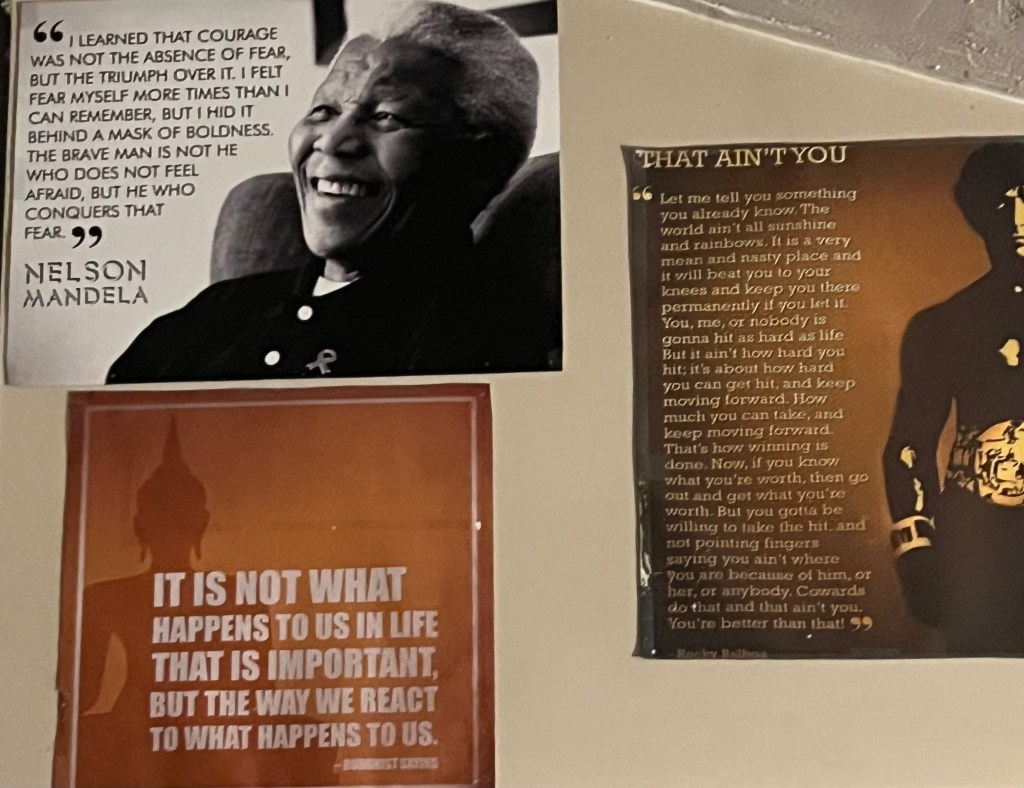
Lauryn is taking another poster off the wall. The quote next to this man’s face reads:
I learned that courage was not the absence of fear, but the triumph over it. I felt fear myself more times than I can remember, but I hid it behind a mask of boldness. The brave man is not he who does not feel afraid, but he who conquers that fear.
“I don’t know,” Lauryn replies to my question, “that he changed the world.”
I’m not sure if Lauryn is asking a question or making a statement. I can see she knows little about this man and I’m in no position to educate her. Moving on, I ask another question sort of absent-mindedly, “When do you think someone will come along and change the world again Lauryn?”
“They won’t Mr. J… Our world is f****d—No changing that.”
Lauryn’s use of the f-word here seems appropriate to me, but I know better than to let her think I agree with her assessment of things. “It’s happened many times in history Lauryn,” I say. “It’s destined to happen again.”
“Someone will come along and destroy the world before changing it the way you’re thinking Mr. J.” —Lauryn stops what she’s doing to look at me— “The internet was the beginning of the end…You know it’s true.”
Lauryn is now using my own words against me: The world is addicted to chaos, it hungers for gossip, conspiracy, and scandal, and this magical internet of ours offers us an all-you-can-eat buffet of it.
Lauryn heard me say some variation of that in my class; she’s regurgitating my words to try and make her point. She heard what she wanted that day and missed the lesson I was trying to teach.
This happens all the time and is one of the many reasons I often hate talking. I was trying to address the problem with the students that day. Not rationalize their pessimistic views.
Broken slightly by Lauryn’s confidence in this doomsday prophecy she throws at me, but understanding it far too well, I fight against her negativity.
“Lauryn,” I say trying to sound confident, “someone will come along and use the internet to change the world for the better. In a way that was impossible without it. In a way we can’t imagine now.”
Lauryn looks at me but doesn’t say anything. Not often is she lost for words but something I said hit home because I see her make a conscious decision not to fight me. Without another word she turns and continues taking posters off the wall.
For a brief moment I feel like the adult and not the child— Maybe she wants to believe me? A hopeful voice in my head wonders.
I never found out what Lauryn’s post from the night before meant. Whatever it was she was not in danger though. Which made me feel better when we all left school.
While this virus has much of the world worried, most everyone seemed more excited by the unknown than scared when we said our goodbyes. Anything stimulating—even something not-so-good or scary even—can feel good to people desperate to feel something I think.
Driving home I replay my conversation with Lauryn from earlier.
So many people think like her. I know I do even if I don’t say it— What if they’re right? … What if this really is the beginning of the end?
The Teacher’s Playlist:
Here I Go Again by Whitesnake
“I don’t know where I’m going, but I sure know where I’ve been.”
*
(End of Chapter 3)
Click here to continue to next chapter…

 Recovery High School